
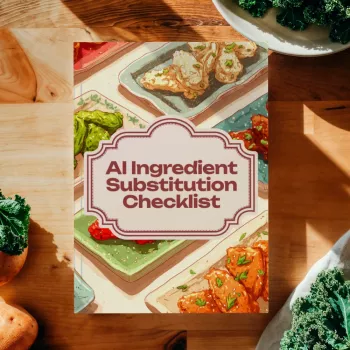
Running out of an ingredient doesn’t have to derail a recipe. With a clear substitution system, it’s easier to protect flavor, texture, and the underlying “why it works”—especially in baking, where small changes can snowball. The AI Ingredient Substitution Checklist (Digital Download) is built for quick decisions and smarter swaps, with a compact structure that works on a phone, tablet, or printed page.
A substitution isn’t just “what tastes similar.” The best results come from tracking the job the ingredient does and the adjustments a swap may require. This checklist is designed to help with:
The fastest way to get useful substitution suggestions is to capture context first, then ask for options with constraints. The checklist keeps that context in one place, so each swap becomes easier to repeat (or avoid) next time.
| Goal | Prompt to paste into an AI tool | What to capture in the checklist |
|---|---|---|
| Replace a missing ingredient | I’m making [recipe]. I’m missing [ingredient] (amount: [x]). Suggest substitutes with exact ratios and any method changes. | Chosen substitute, ratio, method notes |
| Make a recipe dairy-free | Convert this recipe to dairy-free while keeping texture similar. List swaps and any adjustments to mixing or baking time. | Swap list, temperature/time notes |
| Reduce sugar without ruining texture | Suggest lower-sugar alternatives for [recipe] and explain expected texture changes and how to offset them. | Sweetener type, moisture adjustment |
| Swap flours | I need to replace [flour] in [recipe]. Provide options and exact ratios; note if additional binder is needed. | Flour blend, binder, hydration changes |
| Troubleshoot after swapping | My result was [problem]. I substituted [swap]. Diagnose likely cause and propose fixes for next attempt. | Outcome notes, next-step fixes |
When a bake turns out close-but-not-quite, the issue is usually function mismatch: the swap changed moisture, structure, or lift. These guardrails help keep results predictable.
For extra accuracy when converting amounts, a reputable weight reference like King Arthur Baking’s Ingredient Weight Chart can help standardize measurements.
| Ingredient | Practical substitutes | What to adjust or expect |
|---|---|---|
| Egg (1 large) | Flax “egg” (ground flax + water), chia “egg”, applesauce, yogurt | Best for binding/moisture; may reduce lift and add density |
| Butter | Neutral oil, margarine, coconut oil | Oil can increase tenderness; butter replacements may change flavor and browning |
| Buttermilk | Milk + acid (lemon/vinegar), yogurt thinned with milk | Acid affects baking soda activation; texture may be slightly tangier/softer |
| Baking powder | Baking soda + acid (recipe-dependent) | Balance acid; too much soda can taste soapy and darken crumb |
| All-purpose flour | Bread flour, cake flour blend, gluten-free blend | Protein changes structure; GF often needs binder and hydration tweaks |
| Brown sugar | White sugar + molasses (if available), coconut sugar | Moisture and caramel notes shift; cookies may spread differently |
If you want to double-check nutritional differences while comparing pantry options (like milk types or sweeteners), USDA FoodData Central is a practical reference.
For allergy-related swaps, remember that ingredient substitutions don’t replace label reading and cross-contact precautions. The FDA’s food allergy guidance is a helpful baseline for safe decision-making.
It’s a structured decision tool with spaces to record ratios and method notes, and it’s designed to pair with AI or trusted references to fill in exact amounts based on your recipe’s context.
Cooking is usually more flexible, while baking is chemistry-driven. The checklist focuses on ingredient function and adjustment notes to reduce the risk of baking results that look close but eat wrong.
Yes—by prompting you to define the ingredient’s job and track results, it supports planning and repeatability. For severe allergies, always verify labels and take cross-contact precautions.










Leave a comment