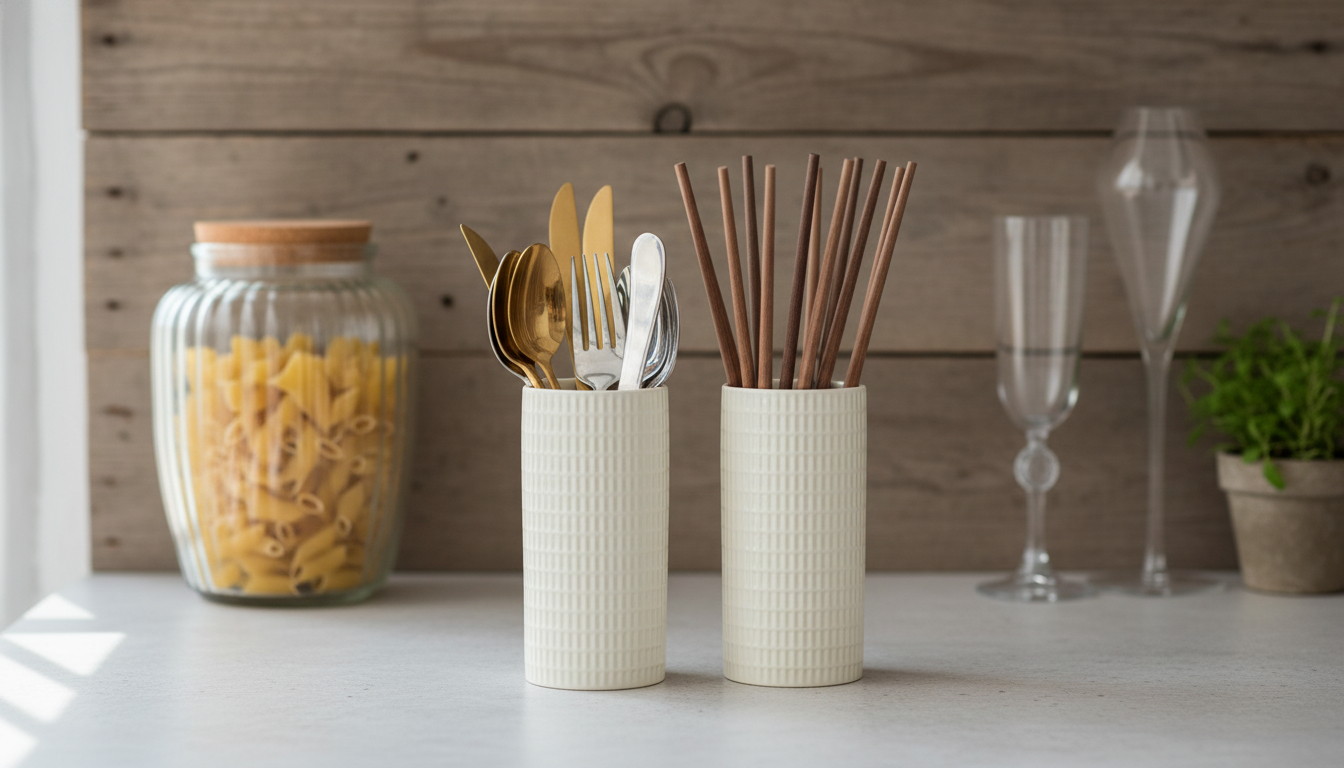
A spoon and chopstick rest keeps utensils off the counter, reduces drips, and brings order to daily cooking. This modern embossed ceramic stand pairs clean lines with a tactile finish, fitting neatly beside the stove, prep board, or coffee station. For kitchens that lean streamlined—open shelving, neutral palettes, fewer items left out—this is the kind of small accessory that pulls its weight without adding visual noise.
When you’re moving fast between sautéing, tasting, and plating, it’s easy for sauce and oil to end up everywhere. A dedicated rest turns that mess into a single, easy-to-clean zone.
Placed between the cutting board and the burner, it becomes a simple rhythm: stir, set down, wipe the rim, and keep cooking—without hunting for a paper towel “parking spot” or balancing utensils on the edge of a pan.
Minimal doesn’t mean bare; it means intentional. The appeal of an embossed ceramic rest is that it reads as calm décor while still feeling considered up close.
If your counters are often visible—think open-concept living or a narrow galley kitchen—this kind of understated accessory helps the space look “finished,” even on busy weeknights.
A rest like this earns its place when it works outside one specific meal. Beyond everyday stir-fry nights, it adapts to small tools and quick routines.
It’s also useful near the sink: set down a spoon after stirring a sauce, then rinse both at once—less streaking and fewer countertop wipe-downs mid-recipe.
Because this is a food-adjacent countertop item, quick cleaning habits matter. A rinse right after cooking prevents residue from hardening and makes washing feel effortless rather than like a chore.
For general kitchen hygiene guidance, the USDA’s food safety basics on keeping kitchens clean is a helpful reference: USDA FSIS: Kitchen Companion—Clean. If you’re curious about materials used around food, the FDA overview of food-contact substances provides additional context: FDA: Food Contact Substances.
The “best” utensil rest depends on how you cook. If you use one main spoon most nights, a compact stand is ideal. If you routinely juggle multiple tools, a larger, multi-slot style may be worth the extra footprint.
| Type | Best for | Pros | Things to consider |
|---|---|---|---|
| Ceramic stand (embossed, minimalist) | Everyday stovetop use; design-forward counters | Stable, easy to wipe, decorative | Can chip if dropped |
| Silicone rest | High-mess cooking; fast cleanup | Non-slip, flexible, often dishwasher-safe | May stain with strong pigments; less rigid |
| Stainless steel rest | Modern/industrial kitchens; heavy use | Durable, resists odor absorption | Can show fingerprints; may slide on smooth counters |
| Multi-slot spoon rest | Cooking with multiple utensils at once | Separates tools, reduces cross-contact | Larger footprint |
Yes—this style of rest is designed to give mixed utensils a single, dedicated landing spot, so you can set down a cooking spoon while keeping chopsticks handy for tasting or plating.
Ceramic is typically easy to clean with a quick rinse and mild dish soap. Cleaning promptly helps prevent dried-on residue, and avoiding abrasive pads helps preserve the finish over time.
Place it on a dry, flat surface and keep the base free of grit that could scratch. If your countertop is very smooth, a small non-slip pad underneath can add extra stability.








Leave a comment